Reusing Past Repairs Through Hierarchical Trajectory Abstraction for Coding Agents
Repair agents resolve repository-level issues, but many handle each issue on its own. STAIR reuses what
earlier successful repairs did. It splits each repair trajectory into stages, keeps every procedure inside it as a
repair recipe at several granularities, from repository-specific steps to broad strategies, and adapts
the recipes that fit a new issue into a plan for each repair stage.
Take-homeNeither too specific nor too vague: keep every granularity, and select per stage.
Reuse benefits from keeping each procedure of a past repair at several levels of detail, and from turning the procedures
selected for a new issue into concrete actions for that issue.
01 · Problem
Reuse a past repair, but at which level?
Experienced developers reuse what worked before: localization strategies, editing procedures, verification steps.
That knowledge exists at different granularities. A concrete procedure, such as checking a particular configuration file,
is actionable but may apply only to closely related issues. A broader strategy, such as tracing data flow backward from a
failure site, transfers more widely but says less about what to do next. Agents that already reuse past repairs (Lingxi,
SWE-Exp, ExpeRepair) fix the unit and the granularity when they extract it: a whole repair, stage-level experience, or a
demonstration plus abstract insights. None splits a past repair into its distinct procedures and keeps each one at several
levels of detail.
Too specific
Reuse the concrete repair as it happened
Concrete steps are actionable but may apply only to closely related issues. A new issue may need a past repair's
localization strategy but not its repository-specific edit; a raw trajectory adds tool outputs, failed attempts and repeated actions.
Concrete steps · example from the paper's Figure 1
Remove the “Add” button
User still added items
Checked why it still worked
Found a hidden shortcut
Too vague
Reuse only an abstract insight
A broad strategy transfers to more issues, but it may omit the actions that made the strategy work, including steps a
closely related issue would need. It gives the agent less guidance on what to do next.
High-level principle · same example
Always enforce intent at every system layer, not just at the visible entry point.
The questionHow can an agent identify the reusable procedures within a
past repair, and represent each at the level of detail a future repair needs? STAIR's answer: keep every level, and let each repair
stage of the new issue draw the recipes that apply.
02 · Method
Keep every granularity; select per stage.
STAIR works in three phases. Phase 1 runs offline, once, before any target repair. Phases 2 and 3 run for
each new issue, separately for each of the three repair stages: localization, planning, and execution-and-verification. A
repair recipe is a reusable procedure or strategy derived from a past repair; a repair plan
instantiates selected recipes for the target issue.
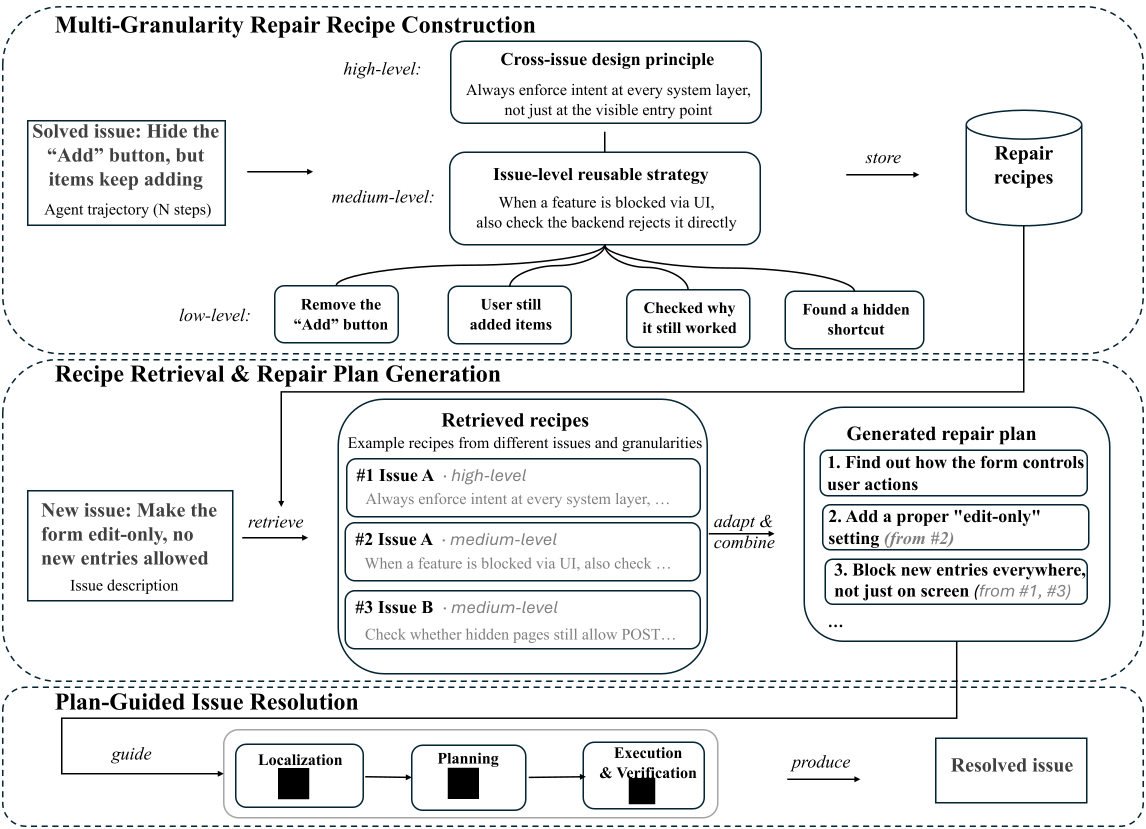
How to readTop to bottom, following the arrows. Phase 1 turns a solved issue's trajectory into recipes at
low, medium and high level and stores all of them. Phase 2 retrieves recipes for a new issue, from different past issues and
granularities, and combines them into a plan; each plan step names the recipes it came from. Phase 3 hands the plan to the
repair agent.
What it showsNo level replaces another: the plan's second step comes from a medium-level recipe, its
third from a high-level and a medium-level recipe of two different issues. Figure 1 of the paper; construction, retrieval and
plan generation are performed separately for each repair stage.
1Phase 1 · offline recipe construction
Split by stage, then abstract level by level.
STAIR runs Lingxi's repair scaffold, with its knowledge-reuse mechanism disabled, on earlier issues of the
same repository and keeps the trajectories of successful repairs. Each trajectory is cut into three ordered segments, one per
repair stage, τ(u) = ⟨τloc, τplan, τexec⟩. Within a segment, an
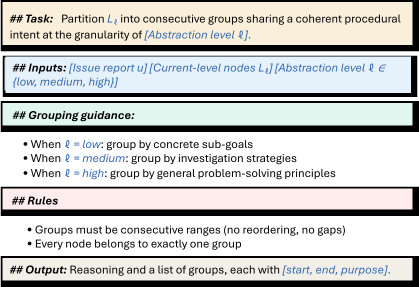
LLM operator Gℓ groups consecutive steps that serve a common repair purpose, and an
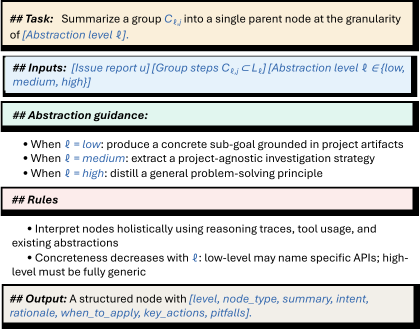
operator Aℓ abstracts each group into one recipe. The recipes are then grouped and
abstracted again, until at most K = 2 remain. Every level is kept.
Recipes are built, and later retrieved, separately for each segment. Below: one segment, as in the paper's example.
High levelgeneral problem-solving principle
Cross-issue design principleAlways enforce intent at every system layer, not just at the visible entry point
G groups related recipes · A abstracts them again
Medium levelproject-agnostic investigation strategy
Issue-level reusable strategyWhen a feature is blocked via UI, also check the backend rejects it directly
G groups consecutive steps by purpose · A abstracts each group
Low levelconcrete sub-goals grounded in project artifacts
Remove the “Add” buttonUser still added itemsChecked why it still workedFound a hidden shortcut
reasoning · action · observation of each step
Sourceagent trajectory, N steps
Solved issue: Hide the “Add” button, but items keep adding
Transfers more widelyMore actionable
Intentwhat the procedure aims to accomplish
Key actionsthe actions used to carry it out
When to applythe conditions under which it is useful
Pitfallscommon pitfalls met during the repair
Every recipe has these fields at every level; only their specificity changes. A low-level recipe may name
specific APIs; a high-level one must be fully generic. Recipes are built once with GPT-5 from 479 historical trajectories
(about $0.44 each, about $211 in total) and shared by all configurations.
Grouping operator Gℓ · Figure 2
← swipe →
How to read: one template for all levels; only the guidance line changes with ℓ. Groups must be consecutive
and cover every node, so the stage's order is kept.Abstraction operator Aℓ · Figure 3
← swipe →
What it shows: each group becomes one recipe with the fields above; concreteness decreases with the level,
from named APIs to a fully generic principle.
2Phase 2 · retrieval and plan generation, per stage
One pool across granularities, one plan per stage.
For a new issue u and each stage s, every recipe from
stage s of the selected past repairs is a candidate, whatever its granularity. STAIR ranks them in one
list by cosine similarity to the issue report (Qwen3-Embedding-8B), and an LLM verifier removes recipes whose procedures do not
apply at this stage. The retained set Rs(u) can mix granularities and source issues. An
LLM then writes the stage plan Ps(u) = Plan(u, Rs(u)): it keeps applicable
guidance, drops irrelevant or conflicting parts, and combines complementary recipes into an action sequence for this issue.
New issue · report only
Make the form edit-only, no new entries allowed
Rank recipes of stage s from all granularities in one list
LLM verifier drops those that do not apply at this stage
Keep order: same-trajectory recipes in execution order, broader before narrower
→
Retrieved recipes Rs(u)
#1 Issue AhighAlways enforce intent at every system layer, …
#2 Issue AmediumWhen a feature is blocked via UI, also check …
#3 Issue BmediumCheck whether hidden pages still allow POST …
→
Generated plan Ps(u)
Find out how the form controls user actions
Add a proper “edit-only” setting from #2
Block new entries everywhere, not just on screen from #1, #3
…
Example from the paper's Figure 1. Retrieval uses only the issue report; repository-specific details in the
plan are checked and adjusted by the repair agent as it explores the target codebase.
3Phase 3 · plan-guided issue resolution
The plan guides the agent; the agent still decides.
Each plan is given to the repair agent in the matching stage. The agent still explores the repository,
applies edits, runs checks and responds to test feedback; when new evidence conflicts with the plan, it can revise its
decisions. The underlying agent remains responsible for constructing and verifying the final patch.
Stage 1
Localization
Ploc(u)
guides the agent toward relevant failure evidence and candidate code locations.
Stage 2
Planning
Pplan(u)
describes the intended modification strategy, the repair scope and relevant constraints.
Stage 3
Execution & verification
Pexec(u)
suggests procedures for implementing the repair and checking it.
Primary scaffold · RQ1, RQ3, RQ4
Lingxi
Its decision logic, tools and three-stage repair process are kept; its original knowledge-reuse mechanism is disabled, and
each stage's prompt receives the STAIR plan for that stage.
Transfer target · RQ2
mini-SWE-agent v2
A minimal bash-only agent. The plans are prepended as an <external_reference_plans> block; its source
code, tool definitions and verification logic are unchanged.
03 · Evaluation
Does multi-granularity reuse pay off?
All experiments use SWE-bench Verified: 500 real GitHub issues from 12 Python repositories, each checked by
developer-written tests. Pass@1 is the share of issues resolved by the final patch of a single agent run. Two backbones, both
with high reasoning (HR): GPT-5 (commercial) and MiniMax M2.5 (open-weight). For each target issue, past issues come from the
same repository, were created before it, and are disjoint from the evaluation instances.
Recipes: built once with GPT-510–15 min per instance$0.84 / instance · MiniMax M2.5$1.60 / instance · GPT-5
RQ1 · comparison with repair agents
Same scaffold, same model: higher Pass@1.
STAIRLingxi, same scaffold & backboneOther agents
GPT-5 (HR)same backbone
live-SWE-agent
68.4
OpenHands
71.8
Lingxisame scaffold, original knowledge reuse
75.6
STAIRLingxi scaffold + recipes
+3.6 pp79.2
MiniMax M2.5 (HR)same backbone
Lingxisame scaffold, original knowledge reuse
74.6
mini-SWE-agent v2
75.8
STAIRLingxi scaffold + recipes
+6.6 pp81.2
Claude 4 Sonnetreported results · different backbone · no STAIR run
SWE-Exp
73.0
ExpeRepairwith o4-mini as fallback
74.6
Lingxi
74.6
Pass@1 (%) · axis starts at 65
6570758085
+6.6 ppMiniMax M2.5 · Lingxi → STAIR74.6 → 81.2, only the knowledge-reuse mechanism changes
+3.6 ppGPT-5 · Lingxi → STAIR75.6 → 79.2, only the knowledge-reuse mechanism changes
How to readRows are grouped by backbone, so within a group only the agent differs; the paper's Table 2
lists the same numbers by agent type. Lingxi in dark grey is the controlled comparison: same scaffold, backbone, tools and
historical issues, with its original knowledge reuse instead of STAIR's recipes and plans. The Claude 4 Sonnet rows are reported
results with a different backbone, so that comparison is less controlled.
What it showsSTAIR reaches 81.2% with MiniMax M2.5 and 79.2% with GPT-5, the highest among the compared
agents under their reported settings. Changing only the knowledge-reuse mechanism adds 6.6 points on MiniMax M2.5 and 3.6 on GPT-5;
GPT-5's higher Lingxi baseline may leave less room. On the same backbones, STAIR is 7.4 points above OpenHands, 10.8 above
live-SWE-agent and 5.4 above mini-SWE-agent v2.
RQ2 · transfer to another agent · MiniMax M2.5
The plans also guide a different agent.
mini-SWE-agent v2+ STAIR plansbars start at zero
Pass@1 on 500 issues
Resolved
mini-SWE-agent v2379/500 · 75.8%
+ STAIR plans405/500 · 81.0%
+5.2 pp · 379 → 405 resolved
per instance
Average steps
mini-SWE-agent v260.45
+ STAIR plans58.18
fewer steps · 60.45 → 58.18
total per instance
Average tokens
mini-SWE-agent v21,244,923
+ STAIR plans1,179,885
−5.2% · 1,245k → 1,180k
How to readmini-SWE-agent v2 has its own architecture, tool interface and prompting strategy. The only
change is the prepended block of STAIR plans, generated from recipes built on Lingxi trajectories. Table 3 of the paper, all
500 instances.
What it showsPass@1 rises from 75.8% to 81.0% (+5.2 points), close to STAIR on Lingxi's scaffold (81.2%).
Average steps fall from 60.45 to 58.18 and tokens per instance by 5.2%: the plans do not just add context, the agent explores
less. This is evidence for one other scaffold, not for agent scaffolds in general.
RQ3 · how plans change agent behavior
Where plans help, and where they fall short.
Gained and regressed instances · Table 4
STAIRMiniMax vs. LingxiMiniMaxshared 363 · solved by both
10
43
+33net
mini-SWE-agent v2 + Plans vs. vanillashared 372 · solved by both
7
33
+26net
← regressedgained →
Why gained · what the plan corrected · Figure 4, rebuilt
The baseline targets the wrong component and cannot recover; the plan points to the correct location from the start, e.g. the upstream serializer rather than the downstream loader.
12 (28%)
17 (52%)
Partial Fix
The baseline finds the root cause but edits only some of the affected code. In django-11138 it fixed a timezone bug for MySQL and Oracle but not SQLite; the plan framed it as a cross-backend audit.
21 (49%)
10 (30%)
Over-modification
The baseline changes more code than needed; the plan keeps the repair to the minimal change, e.g. extending a matching condition instead of rewriting the discovery pipeline.
10 (23%)
6 (18%)
Why regressed · all 17 regressions
8 · plan-related
The plan misses part of the scope
It captures the main direction but not every change; typically the fix needs coordinated updates across several files or
entry points. 5 from STAIRMiniMax, 3 from mini-SWE-agent v2 + Plans.
9 · not plan-related
The plan fits; execution fails
The agent deviates from the plan, makes unnecessarily complex edits, or makes local mistakes such as a wrong API or wrong
arguments. 5 from STAIRMiniMax, 4 from mini-SWE-agent v2 + Plans.
How to readGained means solved only with STAIR's plan; regressed means solved only by the baseline (Lingxi
for STAIR, vanilla mini-SWE-agent v2 for the plan-augmented version). Two authors labeled every such instance from its plan, patch
and full trajectory and resolved disagreements (Cohen's κ = 0.85).
What it showsGains outnumber regressions, 43 to 10 and 33 to 7. Each agent gains where it is weakest:
Lingxi already has an explicit localization stage, so plans mostly widen the fix (Partial Fix, 49%); bash-only mini-SWE-agent v2
most often starts in the wrong place, so plans mostly redirect it (Wrong Location, 52%). Of the 17 regressions, 8 trace back to plans
that miss part of the required scope; in the other 9 the plan fit and execution failed.
Resolved (%) · Δ vs. full system in percentage points · Table 5
Multi-granularity reusefull system · all levels
100/125 · 80.0
Low-level onlysingle granularity
80/125 · 64.0−16.0
Medium-level onlysingle granularity
76/125 · 60.8−19.2
High-level onlysingle granularity
73/125 · 58.4−21.6
Raw trajectoriesno abstraction
72/125 · 57.6−22.4
020406080100
91.4%of stage plans in the full systemuse recipes from more than one granularity
−22.4 ppRaw trajectories instead of recipesthe largest drop among the variants
How to readEach variant changes only what is reused. The 125 instances are difficulty-stratified: 92
(73.6%) medium or hard, with an estimated fix time of at least 15 minutes, and 33 (26.4%) easy. The subset emphasizes harder
issues, so differences on the full benchmark may not be the same.
What it showsThe full pool resolves 100 of 125 (80.0%). Restricting retrieval to one granularity costs 16.0
to 21.6 points; concrete low-level recipes do best of the three, possibly because they are more actionable, yet still trail by 16.0.
Reusing raw trajectories is lowest at 57.6%. The results support keeping recipes at several granularities and selecting among
them per issue and stage.
04 · Threats to validity
What the results do not establish.
The paper states these limits; the numbers above should be read within them.
External
One benchmark, one language
SWE-bench Verified has 500 Python instances from 12 repositories. Results may not carry over to other languages, benchmarks or
proprietary codebases.
External
One source agent, one transfer target
Recipes come from Lingxi trajectories; another source agent may produce trajectories of different quality. RQ2 shows transfer
to mini-SWE-agent v2, not to other scaffolds.
Internal
LLM-built recipes, manual labels
Grouping, abstraction and the relevance verifier are LLM-based; recipe quality can vary with trajectory length, and the verifier
may drop useful recipes or keep inapplicable ones. RQ3's labels involve judgment (κ = 0.85).
Construct
Tests, two models, a sampled ablation
Pass@1 relies on the provided tests, which may accept behaviorally incorrect patches. Two backbones do not establish the same
benefit for other models. RQ4 uses a subset weighted toward harder issues.
05 · Cite
BibTeX
Please cite the arXiv preprint.
@misc{xu2026reusingpastrepairshierarchical,
  title         = {Reusing Past Repairs Through Hierarchical Trajectory
                   Abstraction for Coding Agents},
  author        = {Yisen Xu and Jiayuan Zhou and Ruiqi Pan and Tse-Hsun Chen},
  year          = {2026},
  eprint        = {2607.29658},
  archivePrefix = {arXiv},
  primaryClass  = {cs.SE},
  url           = {https://arxiv.org/abs/2607.29658}
}